



Outdoor apparel has evolved together with our pursuit for adventure. With every new advancement came the possibility of another realm of exploration – even harsher landscapes and more inhospitable environments became worlds left to explore. Some have been fortunate mistakes, and others have been intentionally designed; nevertheless, our enjoyment of the outdoors continues to be made better by these advancements, and DWR is certainly one of them.
What is DWR
DWR is short for Durable Water Repellent, and it’s the first line of defense against inclement weather, preventing the face fabric of your waterproof jacket and pants from becoming saturated.
Chemically speaking, DWR belongs to the abundant world of polymers – fluoropolymers to be exact. These polymers are characterized by carbon-fluorine bonds, which exhibit a high resistance to solvents, acids and bases, such as water. If high school chemistry has been completely wiped from your memory, then remember that a polymer is just a large molecule, composed of many repeated sub-units. Technically, the longer the chain of sub-units, the more effective the DWR is at keeping moisture on the surface of your jacket.
How Does Durable Water Repellent Work
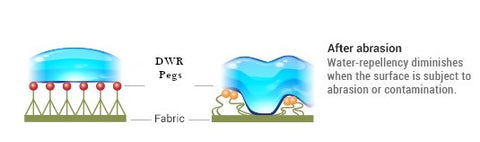
In order to understand how DWR works, it helps to visualize the characteristics of the substance. Once the liquid solution is applied to your outdoor apparel, DWR creates microscopic "pegs" or small filaments that protrude from the face fabric. These small pegs decrease the amount of possible surface area each molecule of water can inhabit. Without a large enough surface to cling to, DWR forces water molecules to “ bead up”, effectively increasing the water’s surface tension such that what would be a puddle is now a ball of water - rolling off the garment effortlessly and not soaking through.
How to Apply DWR to Waterproof Jacket and Pants
A common misconception is that waterproof jackets and waterproof pants should not be washed very often. However, your jacket and pants need to be washed and then re-treated with DWR to maintain performance. As mentioned before, how often you wash and reapply depends on how you use the garment, so make sure you test your gear before you head out!
With every DWR reapplication, you also need to wash the garment to remove unwanted substances that affect breathability and the effectiveness of the new DWR.
Unlike normal laundry detergents, waterproof apparel detergents are specially designed for waterproof jackets and waterproof pants. We highly recommend not using normal laundry detergents while cleaning waterproof apparel, as these detergents can leave unwanted residue, such as perfumes, conditioners, bleaches, softeners, or other waxes or oils.
There are a wide range of products available for washing waterproof apparel, though we recommend Granger Performance Wash, for its Bluesign® approved, PFC-free properties.
After you wash your waterproof apparel, it’s time to apply a fresh coat of DWR. We recommend a spray-on application rather than a wash-in application. DWR is designed for the face fabric of your waterproof apparel. When you use wash-in DWR, you are applying a DWR to the interior of your jacket. Applying DWR to the interior of your jacket reduces breathability and performance; therefore, we highly recommend a spray-on application like Grangers Performance Plus Spray.
Please Note: If you are using a different type of spray-on DWR, it might be necessary to heat treat the jacket after applying a new DWR finish. The introduction of heat to DWR activates those tiny pegs such that they stand straight up. If you are using a DWR that requires heat treatment, then these instructions should be denoted on the bottle.
- Spray directly onto a freshly-laundered, damp garment from roughly 10-15cm / 4-6’’ away
- Let sit for around 5 minutes
- Wipe away any large droplets with a clean towel
- Allow to dry naturally, or if tumble drying, always check the garment’s care label first. Showers Pass jackets can be dried at low temperatures.
PFC-Free DWR: The Better Environmental Choice
Historically, most DWRs used Perfluorinated Chemicals (PFCs). We began moving away from these "forever chemicals" almost a decade ago and removed them from all Showers Pass gear in 2023.
Newer PFC-free DWR treatments are just as effective as the older long-chain PFOA products, but do not last as long without reapplication. This means that newer PFC-free gear needs more frequent washing (which revives the DWR layer) and more frequent re-treating than older gear. We think it's a small price to pay for not participating in the production of PFCs.
When to Replace Your DWR
“Wetting out” can indicate that your DWR requires revitalizing. Common causes of DWR degradation are exposure to dirt, body oils and grease in general, washing, sunscreen, smoke, bug spray, and normal abrasion from regular use. Those small pegs of DWR defense have been compromised in one way or another. Either those small hairs have been knocked down, eliminated, or the space between them has become clogged, allowing cold temperatures and moisture to seep through to the membrane. A jacket that wets out may not let water in, but it can be cold, heavy, and uncomfortable to wear. In some conditions, wetting out can create a temperature differential that causes condensation to accumulate inside the garment.
You might be asking yourself: What’s the point? I have a waterproof membrane for that! Of course the assumption here is that a waterproof membrane is impermeable – no water in, and no water out! Though not entirely inaccurate, waterproof membranes are also micro-porous. A good waterproof jacket should allow body heat to escape, and every consumer should be aware of this.
Long exposure to heavy rains and cold temperatures will push your gear to the limits. That’s why it’s important to keep your waterproof cycling jacket and waterproof pants protected with multiple DWR applications.
How Long Between Applications?
There’s no standardized time frame in which one should reapply a DWR defense. Of course, everyone’s situation will be different given how often and how rigorously one uses their waterproof apparel. As mentioned in the above section, “wetting out” is the most obvious indication that it’s time to reapply a layer of DWR. However, if you are noticing a “clammy” feeling, which is to say the lining of your waterproof jacket feels moist and begins to cling to your skin, then this is also a good indication that a new layer of DWR should be applied.
How to Test Your DWR
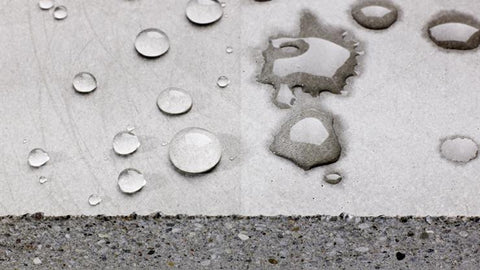
Test your waterproof apparel’s DWR by applying some drops of water to the face fabric. Wait a few minutes to see if those droplets of water remain balled up on the surface. If, however, you notice that the water sits flat against the garment and the area becomes slightly darkened, this is an indication that water is permeating the face fabric and it’s time to reapply.
And that’s it! Your waterproof jacket or Waterproof pants have been given new life. Allowing you to explore the outdoors with all the protection you need to stay dry, warm and happy.
If you have any questions, feel free to contact Showers Pass for details on best practices, or if you have any general questions about DWR.
